



Current Issue

Uncovering a hidden history at St Mary’s Church, Stebbing
Bakers of Danbury delve into the fascinating discoveries at St Mary's Church in Stebbing, uncovered during the recent renovation and restoration programme. The archaeological work and investigations were carried out by Colchester Archaeological Trust.
St Mary’s Church stands at the southern end of the village of Stebbing in north-west Essex and has long been a focal point for the community around it. The settlement itself is ancient – Stebbing appears in Domesday as ‘Stibinga’, a name rooted in the Old English for dwellers among the tree stumps, and the village has occupied the same ground since before the Norman Conquest.
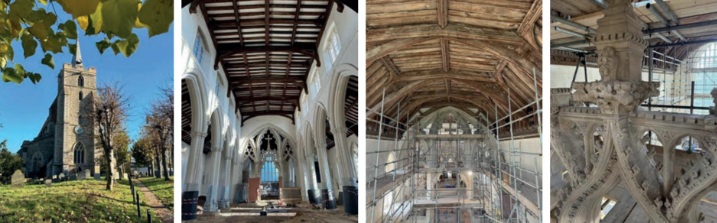 (Left to right) St Mary's Church in Stebbing; the excavated floor; scaffolding in place ; and a stone rood screen
Its recorded Christian history begins in 1181, when William de Ferrers, 3rd Earl of Derby, gave the church and its lands to the Knights Hospitallers of St John of Jerusalem. The present building dates from the 14th century, with its historic stone rood screen one of only three surviving examples in Europe. The screen remains intact and is a fine example of medieval craftsmanship that has defined the interior of St Mary’s for nearly 700 years.
Restoration work uncovers a hidden history
When the church began planning a major improvement programme the ambition was to make St Mary’s fit for modern day community use without compromising its historic fabric. Funded primarily by the National Lottery Heritage Fund, the 48-week programme included underfloor heating, a new limecrete floor, a more accessible entrance, flexible seating and a servery to support the building’s future as a community space. Heritage building contractors Bakers of Danbury were appointed as contractor.
Delivering the work meant excavating into ground that had remained largely undisturbed for centuries, both inside the church and in the surrounding churchyard. As the floor came up and excavations took place, St Mary’s began to reveal its hidden history.
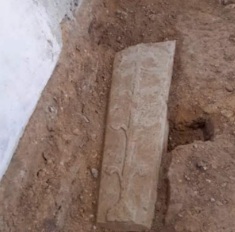
A cross slab grave marker with fleur-de-lis
What was revealed
Colchester Archaeological Trust (CAT) were asked to observe, monitor and record the groundworks. Their involvement began in autumn 2024 as the floor was excavated to make way for the new heating and access works. What they found gave a detailed picture of the building’s long history.
Inside, it quickly became clear that the current restoration was not the first time the building had been modified for warmth. Victorian cast iron pipework laid into brick channels, fed by a small coal-fired furnace, was uncovered during excavation. Worked stone was found near the rood screen, discarded after the Victorian restoration works carried out in 1884.
Fragments of stained and painted glass were also recovered which may have been from damage during the Reformation following Henry VIII’s break with Rome; or possibly during the Civil War when parliamentarian troops are recorded as having used the church as a stable. The glass is being analysed by a specialist with a plan to return it to St Mary’s as part of a permanent display.
Evidence of a history dating back to medieval times was also uncovered. The internal works exposed flint and mortar foundations along the south transept. Dated to the 11th or 12th century, they predate the current 14th-century structure and are believed to be the foundations of the original medieval church.
Another notable find relating to this era was a cross-slab grave marker, decorated with a stylised cross in the form of a fleur-de-lis and dating to the 12th or 13th century. Cross slab markers of this type are more commonly associated with the Midlands than Essex, and it is thought this one is likely connected to a high-status individual buried within the earlier medieval church. The stone has been recorded using photogrammetry to produce a 3D model and remains in situ.
Graveyard discoveries
External excavations along the south and west of the church to accommodate the new fuel system uncovered many burials – 36 in total – along with a significant quantity of disarticulated bone. The burials were densely packed and intercutting, as is typical for a long-used churchyard. The earliest were medieval, dating to the 12th or 13th century with the most recent from the 18th or 19th century, some with coffin furniture of handles and decorative studs still present. The most recent gravestones in that part of the churchyard suggest it went out of regular use by the first half of the 19th century.
The preservation of these was good, allowing CAT’s osteologist to respectfully carry out detailed analysis of the remains. This revealed an equal division of men and women, with the majority aged between 30 and 50. The population appeared broadly healthy, though slightly shorter than average at around 1.65m (5ft 4in) – a characteristic that appears to reflect local population norms rather than any sign of poor nutrition.
Analysis of the bones did reveal some pathologies. This included evidence of childhood rickets in at least one individual and healed fractures, particularly to fingers, consistent with strenuous agricultural labour, and arthritis. One case of spina bifida occulta was also identified, a partial fusion of vertebrae in the lower back caused by a deficiency of Vitamin B and folic acid in pregnancy. It was the mildest form of the condition, with the individual almost certainly having had no knowledge of it.
On completion of the analysis, the remains were returned to St Mary’s and reinterred in the churchyard. A respectful ceremony was held in November 2024.
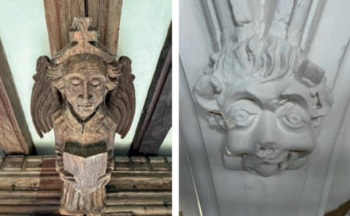
One of the church's carved wooden angels (left) and one of its carved stone faces (right)
A view from above
Not every discovery came from below ground. Scaffolding erected for the works gave rare close-up access to parts of the church usually seen only from a distance. High up on the columns, 16 carved stone faces could be seen, some serene, others full of character. Often called corbel heads or label stops, these were typically placed where roof beams or arches met the columns, being partly structural to hide the join and partly decorative. Masons frequently used them to depict real people including patrons, clergy or even the masons themselves.
Wooden angels, carved centuries ago, were also visible up close for the first time in many years. Sometimes referred to as angel roofs, they are an East Anglian feature of the 14th and 15th centuries, with carved angels set at the base of the roof timbers, wings outstretched, often holding shields or instruments. They were symbolic guardians of the church, watching over the congregation from above, as these do here.
Also accessible from the scaffolding was the detail of the stone rood screen’s carvings and tracery – its carving serving both a devotional and visual purpose, marking the boundary between the everyday and the sacred. Cracks in the screen were repaired as part of the works, helping preserve a feature that has been part of the church for centuries.
The re-opening of the church
In March 2026, with the works complete, the church marked the occasion with a thanksgiving service, described as ‘a once in a generation moment’ for the village. The discoveries made serve as a reminder that conservation work is not only an opportunity to repair historic buildings, but also an opportunity to reveal and understand their hidden history.
Bakers of Danbury are heritage building contractors offering expert conservation and restoration services for historic and listed buildings, churches, museums and ancient monuments. They are committed to preserving our architectural heritage while adapting buildings for the needs of today and the future. For further information visit www.bakersofdanbury.co.uk.
Thanks are due to Colchester Archaeological Trust and the Way Forward Project, whose research informed this article.
VISIT OUR ASSOCIATED SITES